
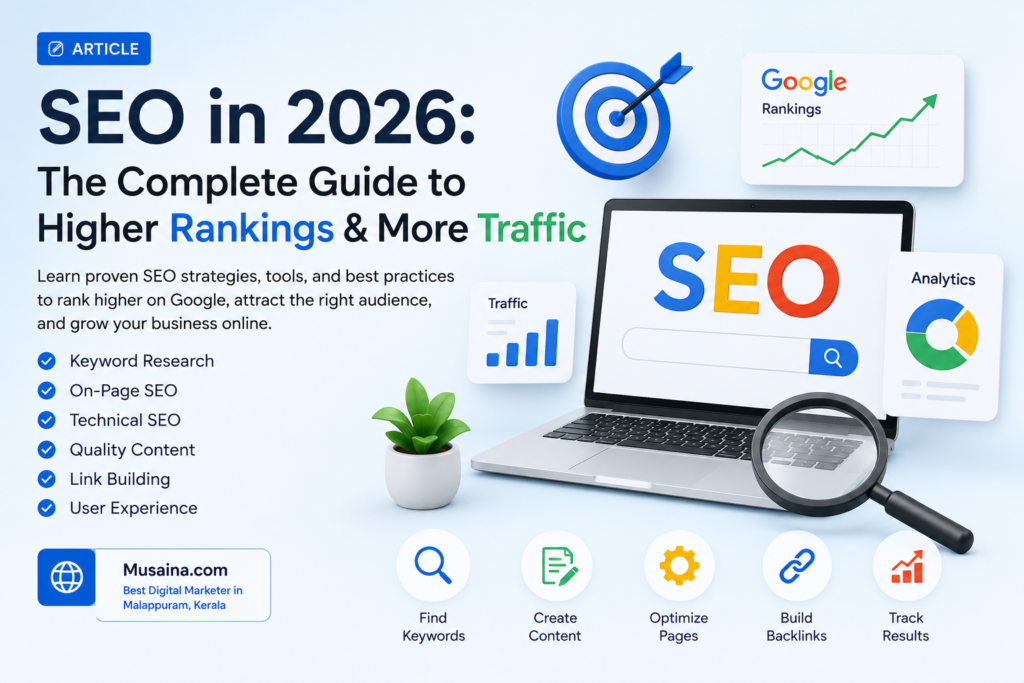
What Is SEO & Why It Matters in 2025
Search Engine Optimization (SEO) is the practice of improving your website so it appears higher in organic (unpaid) search results on engines like Google, Bing, and Yahoo. Unlike paid ads, SEO drives free, long-term traffic that compounds over time — making it one of the highest-ROI digital marketing channels available.
In 2025, SEO has evolved beyond simple keyword stuffing or backlink farming. Google’s algorithms now evaluate hundreds of factors — from page experience and content depth, to E-E-A-T (Experience, Expertise, Authoritativeness, and Trustworthiness). Businesses that ignore SEO risk becoming invisible online while competitors capture their audience.
SEO isn’t a one-time task — it’s an ongoing investment. Brands that commit to consistent SEO see compounding traffic growth that paid ads simply cannot replicate at the same cost.
Imagine this: a potential customer searches on Google for a product or service that your business offers. Within seconds, they choose one of the first websites they see. If your website isn’t there, you’ve likely lost a customer before they even knew your business existed.
That’s why Search Engine Optimization (SEO) remains one of the most powerful digital marketing strategies in 2026.
SEO is no longer just about inserting keywords into a webpage. Modern SEO focuses on creating helpful content, delivering a great user experience, and building trust with both search engines and users. Businesses that invest in SEO gain long-term visibility, attract qualified traffic, and generate consistent leads without relying solely on paid advertising.
Keyword Research: The Foundation of Everything
Keyword research is how you discover exactly what your target audience is typing into search engines. It’s not about picking the most popular terms — it’s about finding the right intersection of search volume, competition, and user intent.
Short-tail Keywords
1–2 word broad terms. High volume, high competition. Example: “digital marketing.”
Long-tail Keywords
3–5 word specific phrases. Lower volume, much easier to rank. Example: “digital marketing tips for small businesses.”
Semantic Keywords
Related terms and phrases that signal topic depth to Google. Crucial for topical authority.
Local Keywords
Geo-specific searches. Example: “SEO agency in Kochi.” Essential for local businesses.
On-Page SEO: Optimize Every Element
On-page SEO refers to all the optimizations you make directly on your web pages. These are entirely within your control, and getting them right is the single fastest way to improve your rankings.
The On-Page SEO Checklist
- Title Tag:Include your primary keyword in the first 60 characters
- Meta Description:Write a compelling 150–160 character summary with a call to action
- URL Structure:Short, clean, and keyword-rich (e.g., /seo-guide-2025)
- H1 Tag:One per page, containing your main keyword naturally
- Header Hierarchy:Use H2s and H3s to structure content logically
- Image Alt Text:Describe images with relevant keywords for accessibility and SEO
- Internal Linking:Link to related pages on your site with descriptive anchor text
- Keyword Density:Aim for natural usage — no keyword stuffing
Pro tip: Place your primary keyword within the first 100 words of your content. Google gives extra weight to terms that appear early in a page’s body text.
Technical SEO: What Search Engines See
Technical SEO ensures that Google’s crawlers can access, understand, and index your website efficiently. Even brilliant content will fail to rank if your site has technical problems blocking the bots.
Page Speed
Google’s Core Web Vitals require pages to load in under 2.5 seconds. Use GTmetrix or PageSpeed Insights.
Mobile-First
Google indexes the mobile version of your site first. A responsive design isn’t optional — it’s mandatory.
HTTPS Security
SSL certificates are a confirmed ranking factor. Every page should load over HTTPS, not HTTP.
XML Sitemap
Submit a sitemap to Google Search Console so all your pages are discovered and crawled efficiently.
Core Web Vitals Explained
Google’s Core Web Vitals measure the real-world experience of users visiting your site across three dimensions: Largest Contentful Paint (LCP) measures loading speed, First Input Delay (FID) measures interactivity, and Cumulative Layout Shift (CLS) measures visual stability. Passing all three signals a high-quality page experience that Google rewards with better rankings.
Content Strategy That Ranks
Content is still king — but only when it matches what your audience is searching for and genuinely answers their questions better than competing pages. Google’s Helpful Content Update has made this clearer than ever: content made for humans, not algorithms, wins.
The Pillar-Cluster Content Model
The most effective content strategy for 2025 is building topical authority through pillar pages and cluster content. A pillar page covers a broad topic comprehensively (like this guide), while cluster content covers related subtopics in depth, all linking back to the pillar. This signals to Google that your website is the go-to expert resource on that subject.
Content Types That Perform
- Long-form ultimate guides (1,500–3,000+ words)
- How-to tutorials with step-by-step instructions
- Original data, case studies, and research reports
- Comparison posts and buying guides
- FAQ pages targeting People Also Ask questions
- Video content with transcripts embedded on the page
Off-Page SEO & Link Building
Off-page SEO refers to actions taken outside your own website that influence your rankings — most importantly, earning backlinks. When reputable websites link to yours, it’s a vote of confidence in the quality of your content. Google interprets these votes as a measure of authority.
White-Hat Link Building Strategies
- Guest Posting:Write valuable articles for industry blogs with a link back to your site
- Digital PR:Create newsworthy content or data studies that journalists want to cite
- Broken Link Building:Find broken links on other sites and suggest your content as a replacement
- HARO (Help a Reporter Out):Provide expert quotes to journalists who link back to you
- Skyscraper Technique:Find top-ranking content, create a better version, and reach out to linkers
Quality over quantity: One backlink from a high-authority site like Forbes or HubSpot is worth hundreds of links from low-quality directories. Focus on earning links from relevant, trusted sources in your industry.
SEO (Search Engine Optimization) is the process of improving your website’s visibility on Google and other search engines to attract more organic traffic and potential customers. As the Best Digital Marketer in Malappuram, Kerala, I offer comprehensive SEO services, including keyword research, on-page SEO, technical SEO, local SEO, content optimization, website audits, and high-quality link-building strategies. My goal is to help businesses achieve higher Google rankings, increase online visibility, drive qualified leads, and grow sustainably.
Local SEO for Business Growth
If your business serves a specific geographic area, Local SEO is essential. It helps you appear in the Google Local Pack (the map section at the top of local search results) and rank for near-me searches that have incredibly high commercial intent.
Local SEO Quick Wins
Google Business Profile
Claim and fully optimize your Google Business Profile with photos, hours, services, and regular posts.
Reviews Strategy
Actively request reviews from satisfied customers. Respond to every review — positive and negative alike.
NAP Consistency
Your Name, Address, and Phone number must be identical across your website, Google, and all directories.
Local Landing Pages
Create separate pages targeting each city or neighborhood you serve to capture hyper-local searches.
AI & the Future of Search
2025 is the year AI search went mainstream. Google’s AI Overviews (formerly SGE) now appear at the top of many search results pages, summarizing answers from across the web. This has reshaped how users interact with search — and how SEOs must think about optimization.
How to Optimize for AI Search
- Write clear, structured content with direct answers to questions
- Use schema markup (structured data) so AI can parse your content accurately
- Build strong E-E-A-T signals — AI tends to source from trusted, authoritative sites
- Optimize for Featured Snippets, as these often feed AI Overview answers
- Create conversational content that matches natural language voice searches
The big shift: Users are asking questions in complete sentences more than ever — especially with voice search and AI assistants. Optimize your content to answer specific, question-based queries naturally and completely.
CONCLUSION
SEO continues to be one of the smartest investments a business can make. While search algorithms evolve, one principle remains constant: businesses that provide value, build trust, and create excellent user experiences are more likely to succeed.
Whether you’re launching a new website or improving an existing one, investing in SEO today can create lasting results for years to come.
If you’re looking for the Best Digital Marketer in Malappuram, Kerala, visit https://musaina.com/ to learn how professional SEO strategies can help your business rank higher, attract more customers, and grow with confidence.
Ready to Dominate Search Results?
Let’s build an SEO strategy tailored to your business goals and market .Work with Musaina